KKD Blog
Trial Balance vs Balance Sheet: What's the Difference?
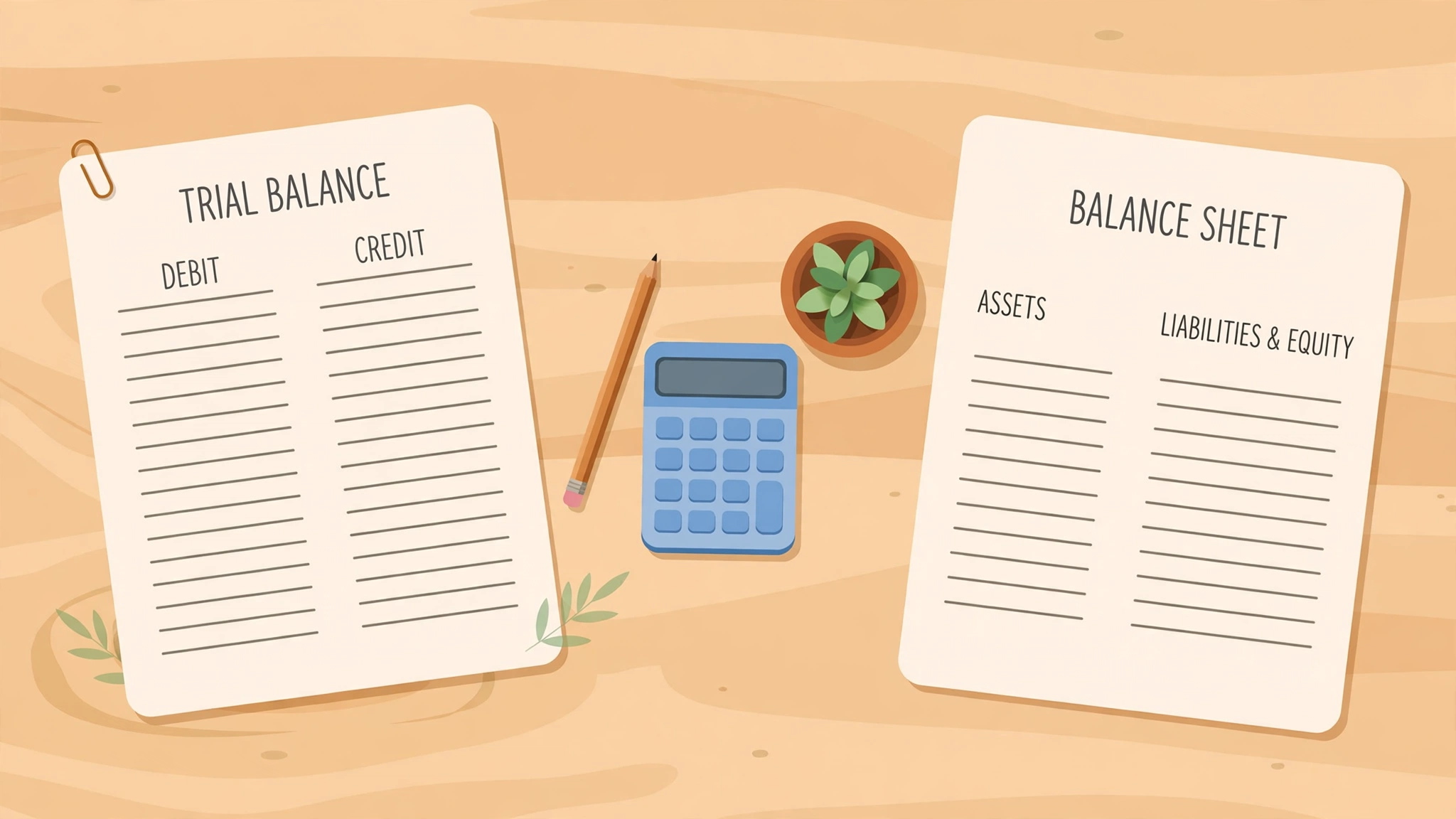
Ask an FA1 student to name the two documents that must balance, and you will usually get the same answer twice: the trial balance and the balance sheet. Both have two sides, and both sides must agree — and that similarity is exactly why students mix them up. They are not two versions of the same thing. One is a working check done behind the scenes; the other is a finished statement shown to the world.
What a Trial Balance Actually Is
A trial balance is a list of every balance in the ledger at a given date, sorted into a debit column and a credit column. If double entry has been done properly, the two columns add up to the same total — and that agreement is the whole point. The trial balance answers one question: have we recorded every transaction twice, once as a debit and once as a credit?
Think of a karyana store owner at the end of the month. His ledger holds cash, stock, suppliers, sales, rent, wages. The trial balance pulls every balance onto one page so he can check the books agree before going further. It is an internal document — never published, never shown to a bank — and it can be prepared at any point in the period.
Two details matter for your exam. First, it contains all ledger balances, including revenue and expense accounts such as sales and wages. Second, it is not a financial statement: it proves the books balance, but says nothing on its own about whether the business is doing well.
What a Balance Sheet Actually Is
A balance sheet — called a statement of financial position in modern exam language — is a formal financial statement. It shows what a business owns and owes at a single point in time: assets on one side, liabilities plus the owner's capital on the other. The two sides agree because of the accounting equation: assets always equal liabilities plus equity.
Unlike the trial balance, it is a public-facing document: it goes to the owner, the bank, the tax authorities and anyone else entitled to see the financial statements. It follows a set format — non-current assets before current assets, for example — because strangers must be able to read it and compare it with other businesses.
And it contains only a slice of the ledger. Revenue and expense accounts do not appear at all: sales and wages have already been closed off into profit for the period, and only the resulting profit (inside capital) reaches the statement. A balance sheet is a snapshot at one date, usually the year end — not a running check you can pull at any moment.
The Differences, Side by Side
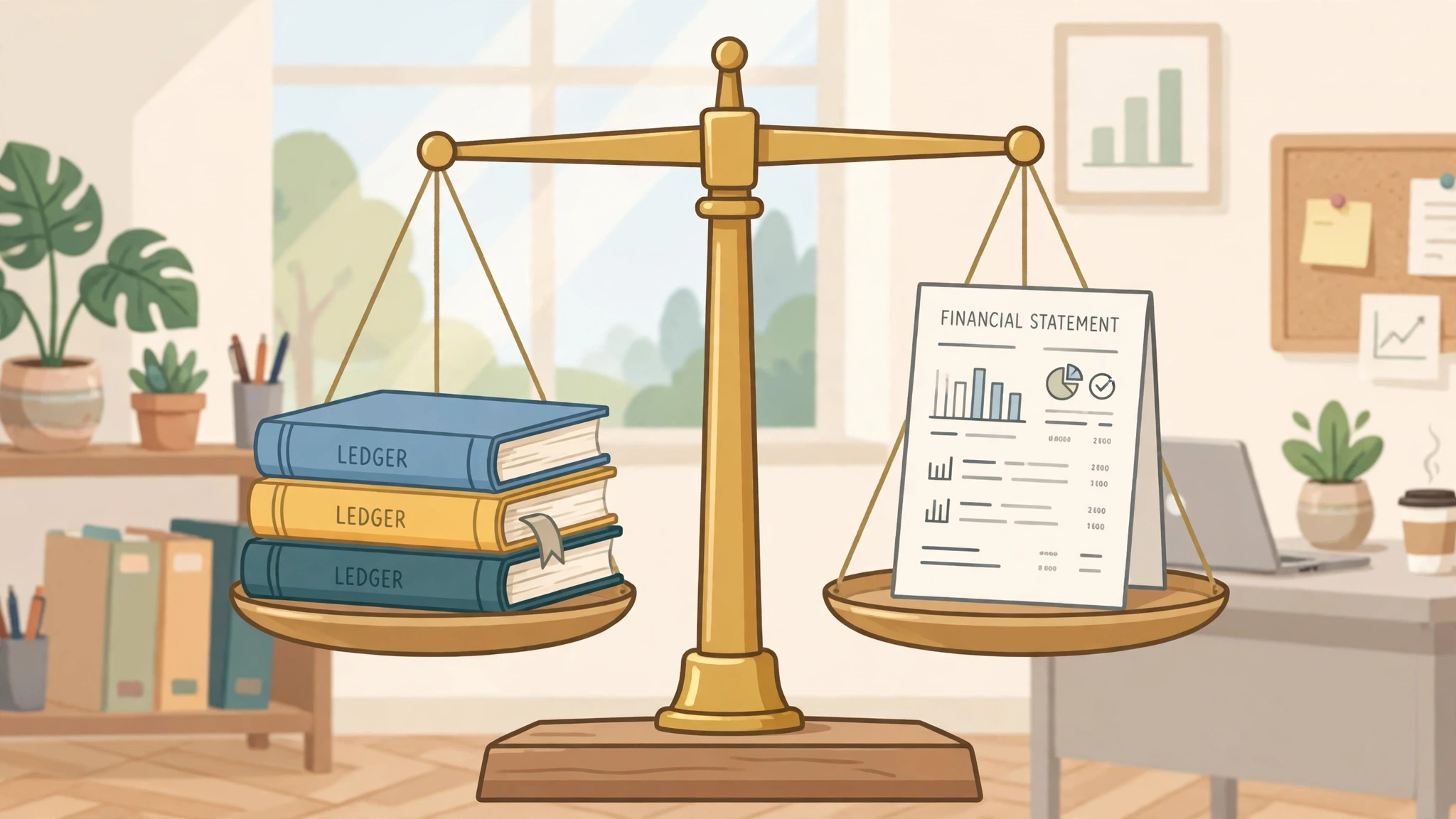
Purpose is the sharpest dividing line. The trial balance checks the arithmetical accuracy of the books; the balance sheet reports the financial position of the business. One is a tool for the bookkeeper, the other is information for decision-makers.
Audience follows from that. The trial balance is internal — the accountant and nobody else. The balance sheet is external — owners, lenders, investors and regulators. That is also why only the balance sheet must follow a prescribed format: a published statement must be comparable, while an internal checklist can look however the bookkeeper likes.
Content is the third difference, and the one examiners test most. The trial balance lists every ledger balance, including income and expenses. The balance sheet lists only assets, liabilities and capital at the reporting date. And timing is the fourth: a trial balance can be drawn up whenever you like, while a balance sheet is prepared at the end of a reporting period.
How They Connect: The Trial Balance Comes First
Here is the sequence FA1 questions are built around. Transactions are recorded in the ledger using double entry. The trial balance is extracted to check the debits equal the credits. Adjustments are then made — for accruals, prepayments and depreciation, which the trial balance alone does not capture. Only then are the financial statements prepared: the income statement from the revenue and expense balances, and the balance sheet from the asset, liability and capital balances.
So the trial balance is not a rival of the balance sheet; it is its raw material. Get the order wrong in an exam answer and the whole narrative falls apart, even if every individual definition is right.
Your Questions, Answered
If the trial balance balances, are the books error-free? No — the classic FA1 trap. A trial balance only catches errors that break the debit-credit equality. It misses errors of omission (a transaction never recorded), errors of commission (posted to the wrong account of the same type), errors of principle (a capital item treated as revenue, or vice versa), and compensating errors that cancel each other out. Balanced books can still be wrong books.
Is the trial balance part of the financial statements? No. The financial statements are the income statement and the statement of financial position; the trial balance is a working paper that helps prepare them — essential backstage, invisible on stage.
Which one do I prepare first in an exam question? Always the trial balance: check it first, make the adjustments, then build the statement from the remaining asset, liability and capital balances.
The Takeaways
- A trial balance is an internal check of all ledger balances; a balance sheet is a formal statement of financial position.
- The trial balance includes income and expenses; the balance sheet includes only assets, liabilities and capital.
- The trial balance can be prepared at any time; the balance sheet reports a single point in time, usually the period end.
- Order matters: ledger, then trial balance, then adjustments, then financial statements.
- A balanced trial balance does not prove error-free books — several error types leave it perfectly balanced.
The Bottom Line
Remember it this way: the trial balance is the accountant checking their own work, and the balance sheet is the business presenting its position to the world. One asks, "do my books agree?" The other declares, "this is what we own and owe." Learn that distinction — and the order that connects them — and a whole family of FA1 questions answers itself.
Ready to test it? The KKD Exam Practice Portal has free FA1 mocks — 301 MCQs plus the full Kaplan kit — so you can practise trial balances, adjustments and statements of financial position until the order feels automatic.
Keep reading
- AI Companies Are Hiring Accountants to Teach Their AI
- Is Accounting Dead? What AI Can (and Can't) Take From the Profession
- FA1 vs MA1: Which ACCA Exam Should You Take First?
- FA1 vs FA2 vs FA: ACCA's Paper Names, Finally Explained
- What Is the Double Entry System? A Beginner's Guide
- Cash vs Accrual Accounting: What's the Difference?
- What Is Management Accounting? A Student's Guide